REVIEW · LJUBLJANA
Ljubljana Castle: Time Machine Guided Tour + funicular
Book on Viator →Operated by Ljubljana Castle · Bookable on Viator
Time travel has a real-world itinerary. What makes this one fun is the guided tour plus time stations inside Ljubljana Castle, where history comes alive through costumed scenes and an English-speaking guide. You’ll move from Roman-era hints to medieval drama and on into later periods, with the castle itself acting like your timeline.
I especially like how the experience mixes storytelling with specific stops that make you look at the site differently, not just read plaques. Another win is the skip-the-line access built into the plan, so you spend less time dealing with queues and more time inside the castle complex. One drawback to keep in mind: you’ll need to handle funicular-side ticket pickup, and that office can have a line, so arrive early to avoid missing the start.
In This Review
- Key things to know before you go
- Your Ljubljana Castle timeline, from hilltop views to story scenes
- Funicular first: where timing can make or break your start
- Inside the castle: how the guide uses “time stations” to teach
- Roman hints up at the observation tower
- St. George at the entrance: medieval drama with a local twist
- Habsburg pageantry in the courtyard (Emperor Frederick III)
- The 19th-century penitentiary: when the story turns darker
- Early 1900s ownership: Mayor Ivan Hribar and the castle’s modern chapter
- What your admission ticket lets you do (beyond the guided portion)
- Price and value: what you’re paying for (and why it’s not just a gimmick)
- Who this tour suits best (and who should consider a different approach)
- Funicular and pet notes you should not ignore
- Should you book the Ljubljana Castle Time Machine tour?
- FAQ
- What language is the tour offered in?
- How long is the tour?
- Does this tour include skip-the-line access?
- Where do I need to pick up tickets for the funicular part?
- Can I choose a departure time?
- How big is the group?
- Are children allowed?
- Are pets allowed?
- What’s the cancellation window if my plans change?
Key things to know before you go
- Skip-the-line entry helps you get into Ljubljana Castle without the main hassle
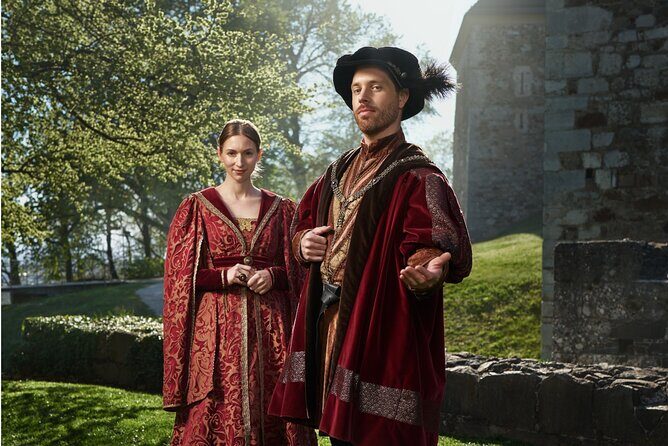
- Costumed scenes at time stations feature Roman, medieval, and later-era characters
- Iconic stops include the observation tower, the castle entrance dragon story (St. George), and the courtyard
- 19th-century penitentiary scenes add a darker, more human side to the timeline
- Small group size (max 30) keeps the pace from feeling rushed
- Funicular logistics matter since you pick up tickets from the funicular office before the tour
Your Ljubljana Castle timeline, from hilltop views to story scenes
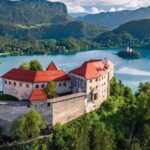
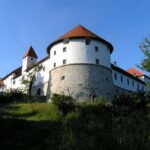
Ljubljana Castle is already one of those places that makes you pause. Even before the tour starts, the setting—on its hill above the city—pulls you into the idea that you’re standing somewhere important. This tour then turns that viewpoint into something more specific: you get a guided “walk through time,” staged in short scenes at different points around the castle.
Instead of a lecture-style history tour, you’ll follow your guide as they shepherd the group from one scene to the next. At each time station, costumed actors step in and set the moment. That matters because it changes how you remember details. A name becomes a character. A date becomes a moment you can picture.
Also, this is designed to fit real travel rhythms. There are departure times through the day, and you get pre-arranged entry so you’re not stuck trying to match your schedule to the castle’s busiest moments.
You can also read our reviews of more guided tours in Ljubljana


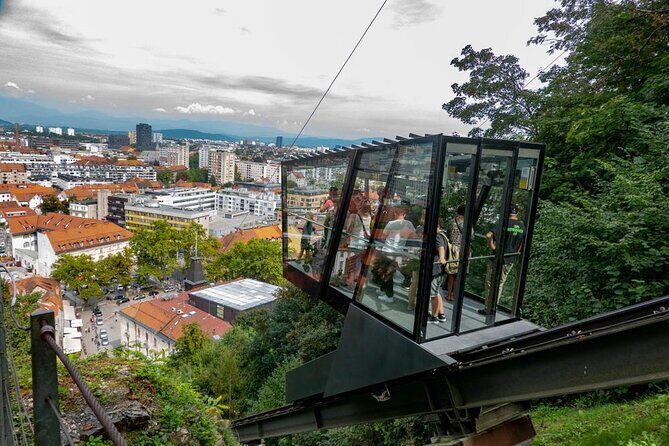
Funicular first: where timing can make or break your start
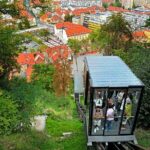
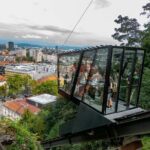
This experience pairs with the funicular, and you should treat that part as part of the tour, not just transport. The practical piece: you’re expected to make your way to the castle in time for your departure, and you’ll also need to pick up your tickets at the funicular office before the tour begins.
Here’s the key consideration: the funicular ticket pickup area can have a long queue. If you show up right at the departure time, you may end up sprinting across a large site with a group that’s already starting. If you want a smooth experience, plan to arrive earlier than you think you need, then take a deep breath and get your ticket handled first.
One more logistics tip: the tour is in English, and the group is capped at 30. That usually means the guide keeps things moving. If you’re late, you can lose the start of the story—exactly when you want the momentum.
Inside the castle: how the guide uses “time stations” to teach
Once you’re in, the tour is built around short, staged chapters. You don’t just pass rooms; you move through a sequence. The guide leads you around Ljubljana Castle to different stations, and each station is basically a mini performance tied to a historical period.
What I like about this format is that it helps you connect the castle’s physical layout to its changing role over centuries. Instead of thinking of the castle as one static building, you start noticing how different eras used the same spaces for different purposes.
You also get a sense of scale. Ljubljana Castle is a complex, not one small room. The tour routes you through enough of it to feel satisfying, but it still leaves you with the option to use your included admission ticket to roam a bit afterward.
Roman hints up at the observation tower
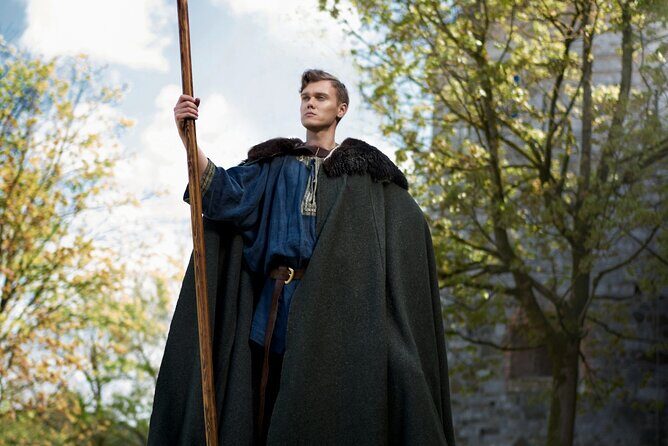
One of the most memorable early beats is the Roman stop. You’ll meet a Roman soldier at the observation tower. That location isn’t picked randomly. High points like this naturally connect past and present: you’re not just hearing about who watched the landscape. You’re standing where watching would actually have made sense.
When a tour gives you one “anchor moment” like this—one character placed at one spot—you’re more likely to remember the rest. The Roman scene also sets up a theme: Ljubljana’s story doesn’t start at the medieval castle walls. It’s a layered place.
If you like history that feels grounded in geography, this part works well. You can look out over Ljubljana from the tower area, then return to the tour line with a clearer idea of why forts and control points matter.
St. George at the entrance: medieval drama with a local twist
At the castle entrance, you’ll hear the story of St. George and the heroic dragon-slaying. This is one of those legends that many people have heard in general terms, but here it’s tied directly to the castle experience, turning a well-known theme into something you encounter at the actual threshold of the site.
I like how this scene functions as a reset. After the Roman stop, the medieval entrance story gives you a different mood: more myth, more ceremony, more symbolism. It also helps you read the castle visually. Entrances are where power announces itself, where visitors would have been expected to behave like part of the story.
So even if you’re not a die-hard legend fan, the entrance scene gives the tour energy and makes the medieval portion feel like it has stakes.



Habsburg pageantry in the courtyard (Emperor Frederick III)
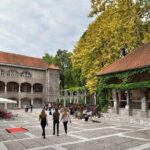
The tour then moves into the courtyard for a scene with Emperor Frederick III of the Habsburgs. This is where the acting really helps you shift from legend and early eras into more formal rule and governance.
Courtyards are built for gatherings, announcements, and public presence. When you meet an emperor figure there, the spot starts to make sense beyond being “a nice open area.” It becomes a stage for how authority played out.
This segment is also valuable because the Habsburg period is a big part of Central European history, but it can feel abstract if you only read a timeline. Here, you’re given a character and a moment to attach to what you might otherwise file away as names and dates.
The 19th-century penitentiary: when the story turns darker
As the tour progresses, you head toward a 19th-century penitentiary scene. Here you meet a guard or prisoner, depending on how the program unfolds that day.
This part adds weight. The castle isn’t only about defense and ceremonies; it also served as a place where people were controlled. In a time-travel format, shifting from pageantry to confinement is a smart storytelling choice. It keeps the tour from feeling like a parade of costumes and lets you see that history has consequences.
If you’re the type who likes human stories—people making choices, people suffering under systems—this is a strong moment. It also breaks up the timeline so you don’t feel like you’re only moving through “cool eras” for entertainment.
Early 1900s ownership: Mayor Ivan Hribar and the castle’s modern chapter
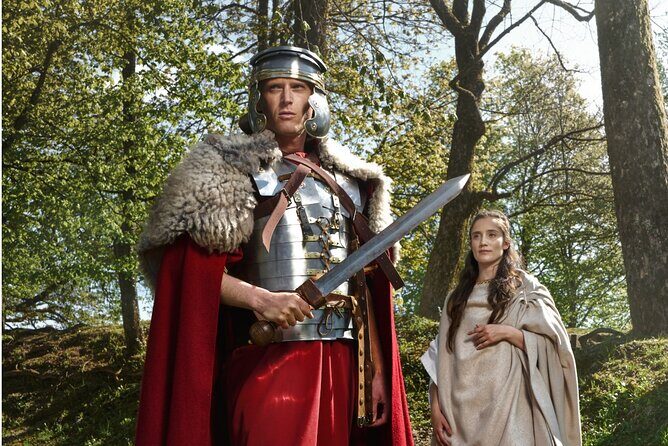
Later in the tour, you may meet Mayor Ivan Hribar, who bought the castle in the early 20th century. This is a helpful bridge to the “present” side of Ljubljana Castle’s story—how the place transitioned from an older function into something cared for, preserved, and visited.
It also gives the tour a local anchor. You’re not only learning about distant rulers and big dynasties. You’re learning about someone tied to Ljubljana’s own civic history.
This part is especially useful if you want to understand why the castle looks the way it does today. Without a modern ownership perspective, older structures can feel like museum pieces. With Hribar’s role in the story, it becomes clearer that someone made decisions about preservation and future use.
What your admission ticket lets you do (beyond the guided portion)
The guided portion ends back at the castle entrance. You also get an admission ticket included, which opens the door to additional castle spaces and exhibits.
Depending on your interest and time, you might look into:
- The viewing tower
- The museum of puppetry
- The Museum of Slovenian History
- A Virtual Castle experience
- Some temporary exhibitions
This is where the value really shows. The guided tour gives you the storyline and the most memorable “time station” moments. The included admission ticket lets you follow your curiosity afterward—whether that means lingering for more context in museum spaces or doing a second look at viewpoints from the tower area.
Practical note: because you’re adding extra sites, you may want to budget your energy. Wear shoes you can handle on uneven surfaces and stairs, since castle complexes always ask more from your legs than flat-town walks.
Price and value: what you’re paying for (and why it’s not just a gimmick)
At $27.76 per person, this isn’t the cheapest way to visit Ljubljana Castle. The question is what you get for that price.
You’re paying for:
- Skip-the-line access to the castle
- A guided route built around costumed actors at multiple stops
- An English-language tour with time slots throughout the day
- A group size capped at 30 travelers
- Included admission to castle areas (not only a walk-by)
For many visitors, the skip-the-line piece is the quickest justification. Ljubljana Castle can draw crowds, and a pre-planned entry keeps your day on track. Then the acting-based storytelling is what turns the entry ticket into an experience, not just a self-guided stroll.
Is it worth it? If you like history presented with character, and you’d rather spend your time learning through scenes than reading walls of text, yes. If you prefer total freedom to wander on your own schedule and read at your own pace, you might find DIY visit options better suited—especially if you already know the major periods and want to go straight to the exhibits.
Who this tour suits best (and who should consider a different approach)
This works especially well for you if:
- You want a guided route with clear structure rather than planning your own path
- You like interactive storytelling and costumed scenes
- You’re visiting for a limited time and want the highlights of the castle experience organized into one timeline
It may be less ideal if:
- You need lots of quiet time. The tour format is active, and actors have staged moments.
- You’re hoping for a strictly academic history tour. This is story-driven, designed to entertain and explain through scenes.
Family-wise, it’s built to include kids—just remember that children must be accompanied by an adult. The tour is marked as suitable for most travelers, but castle sites always involve walking, steps, and uneven ground.
Funicular and pet notes you should not ignore
This is a fun add-on, but plan ahead if you’re traveling with a pet.
- Dogs must be securely muzzled and held on a leash in the funicular railway.
- Dogs may enter the castle courtyard, but they’re not permitted in indoor and event areas.
If you’re bringing a dog, decide early how your route will work during the tour so you’re not stuck at a boundary point.
Service animals are allowed, and the area is near public transportation, which helps if you’re combining the castle with other sights around Ljubljana.
Should you book the Ljubljana Castle Time Machine tour?
Book it if you want the castle to feel like a story with momentum. The combination of skip-the-line entry, English guiding, and actors at real locations (Roman soldier, St. George at the entrance, Emperor Frederick III in the courtyard, penitentiary scenes, and Mayor Ivan Hribar) makes this one of the more memorable ways to get oriented at Ljubljana Castle.
I’d skip it or consider a different option if you hate structured tours or you’re determined to spend your time purely reading museum materials at your own speed. Also, if you’re the type who always shows up late, don’t gamble on funicular ticket pickup lines—arrive early so you catch the first minutes.
FAQ
What language is the tour offered in?
The tour is offered in English.
How long is the tour?
It runs about 1 hour, and the castle admission included with the experience is connected to a 2-hour window at the castle stop.
Does this tour include skip-the-line access?
Yes. The experience is described as providing skip-the-line access to Ljubljana Castle.
Where do I need to pick up tickets for the funicular part?
You pick up tickets from the funicular office before the tour. The tour note also indicates you should go there in time to avoid delays.
Can I choose a departure time?
Yes. There are departure times throughout the day.
How big is the group?
The experience has a maximum group size of 30 travelers.
Are children allowed?
Children must be accompanied by an adult.
Are pets allowed?
Service animals are allowed. Dogs must be muzzled and held on a leash on the funicular railway, and while dogs can enter the castle courtyard, they are not permitted in indoor and event areas.
What’s the cancellation window if my plans change?
You can cancel up to 24 hours in advance for a full refund.